Receive first-hand news on the latest bond issues, credit updates and special events when you join us on our Telegram channel at https://t.me/bondsupermart!
Highlights:
- Bank of East Asia (BEA) retained fast-growing net interest income in 2023, while non-interest declined modestly, and profit attributable to shareholders saw a dip due to higher credit impairment loss.
- BEA is reducing exposure to Chinese real estate developers, but the results are not as good as we expected. Non-performing Loan (NPL) ratio stood at 2.7%, above the industry average, and there is ample room for improvement in asset quality. CET1 ratio hit 17.3%, which is one of the best levels in the banking system, hinting at a decent capability to withstand risk.
- Bonds due in 2027 yield 6.6%, which stands out among bank bonds, making them attractive investment choices.
Last year, we highlighted the bond investment opportunity of BEA,
a Hong Kong-based bank with a relatively good credit profile and high bond
yields, offering attractive choices among bank bonds. BEA recently launched its
annual report for 2023, let's look at the bank's latest operation and credit.
Interest Income Business Maintains Rapid Growth Amid Interest Rate Hike Cycle
Table 1 demonstrates that the BEA's net interest margin saw 50 bps growth in 2023 to 2.14% owing to positive impacts from the rate hike cycle, indicating a strengthened capability to generate interest income through interest-earning assets. Although the high-interest rate environment somewhat dampened the demand for credit, leading to a 3% decline in loans at the end of 2023, the net interest income still surged by 24.9% YoY, outperforming the industry average.
Looking ahead, given the resilience of the global economy, we believe the high-interest rate will last a longer period, even if the market expects some rate cuts within this year. BEA is expected to maintain favorable operations, with net interest income growing at a double-digit rate.
Table 1: BEA’s income and Profit
|
(Billion HKD) |
2022 |
2023 |
YoY Change |
|
Net Interest Margin |
1.65% |
2.14% |
50 bps |
|
Net Interest Income |
13.5 |
16.9 |
25.2% |
|
Non-interest Income |
4.5 |
3.9 |
-13.3% |
|
Total Income |
18.0 |
20.8 |
15.5% |
|
Impairment losses |
5.9 |
6.2 |
5.1% |
|
Pre-provision Profit |
8.7 |
11.3 |
29.9% |
|
Net Profit |
4.4 |
4.1 |
-6.8% |
|
Sources: Company report, iFAST Compilations Data as of 31 December 2023 |
|||
Profitability Saw an Improvement, but Credit Impairment Weighs On Net Profit
Diving into non-interest segments, the weak market sentiment resulted in a 4.1% decline in net fee and commission income and a 24.1% decline in trading and related income. Taken together, non-interest income decreased by 13.3% to HKD 3.9 billion. As a traditional commercial bank, over 80% revenue of BEA comes from interest income, amidst the higher interest income, the bank’s full-year revenue was around HKD 20.8 billion, up 15.6% YoY. The profit before impairment loss surged by 29.6% to HKD 11.3 billion, which is a pretty good quality of earnings.
However, investors may note that the company's profit attributable to shareholders in 2023 fell by 6.8%, which seems to be out of line with the good operational results. The key reason behind this is due to credit impairment losses of HKD 6.2 billion in 2023, an increase of 5% from one year ago, and the loss amount lies at an all-time high. Credit impairment means that a bank's loans are uncollectible because of bad debt (please refer to the asset quality section below for more details).
NPL Ratio Rose Mildly, Reducing Exposure to CRE Will Be Helpful in Improvement of Asset Quality
In terms of asset quality (Table 2), BEA's non-performing loans surged by 61% to HKD 8.1 billion in 2023, and the NPL ratio also rose by 0.5 percentage points to 1.5%, while both bad debt and bad debt ratio went up to varying degrees, reflecting a weaker asset quality. We see that BEA lowered its provision for bad debt whilst bad debt expanded, resulting in a provision coverage ratio of 35.8%, a 15 percentage points drop from the previous year, indicating that BEA's impairment provision is not adequate. We thus believe BEA is motivated to increase the impairment provision moving forward, which may lead to a significant reduction in net profit.
Table 2: Asset Quality of BEA
|
(Billion HKD) |
2022 |
2023 |
Change |
|
NPL |
5 |
8.1 |
+61.2% |
|
NPL Ratio |
0.9% |
1.5% |
+0.6 Percentage Point |
|
Bad Debt |
13.2 |
14.3 |
+9.0% |
|
Bad Debt Ratio |
2.40% |
2.70% |
+30 bps |
|
Impairment Provision |
5.9 |
5.5 |
-7.4% |
|
Provision Coverage Ratio |
50.4% |
35.8% |
-14.6 Percentage Points |
|
Sources: Company report, iFAST Compilations Data as of 31 December 2023 |
|||
If we look at the geographical breakdown of NPL (Table 3), China is the major drag on BEA's asset quality, with the NPL ratio and bad debt ratio reaching 3.1% and 4.9%, respectively, much higher than those in Hong Kong and other regions. The reasons behind this are not new to us, as BEA has much exposure to China real estate, with over 10% of its loans lent to Chinese property developers at its peak (Chart 1), and BEA's asset quality is somewhat weighted by the default crisis of property developers. It is noteworthy that the proportion of BEA's lending to Chinese property developers dropped to 7.1% ending 31 December 2023.
On the other hand, BEA’s NPL ratio and bad debt ratio unexpectedly increased in 2023, which looks to be contrary to the company's lower exposure to Chinese Real Estate. Our view regarding this is that some property development loans have longer tenors and were even lent out to defaulted Chinese property developers before the market downturn, and the credit risk exposure has not yet been fully realized, which is somewhat lagging behind the adjustment of loan origination. Overall, we believe the BEA’s asset quality will improve, and the NPL ratio and bad debt ratio trend downward following the lower exposure to the Chinese property sector.
Table 3: BEA’s Bad Debt Breakdown by Geography
|
NPL Ratio |
Bad Debt Ratio |
|
|
China |
3.10% |
4.90% |
|
Hong Kong |
0.90% |
1.90% |
|
Other Regions |
0.30% |
0.90% |
|
Sources: Company report, iFAST Compilations Data as of 31 December 2023 |
||
Chart 1: BEA’s Loans to Chinese Property Sector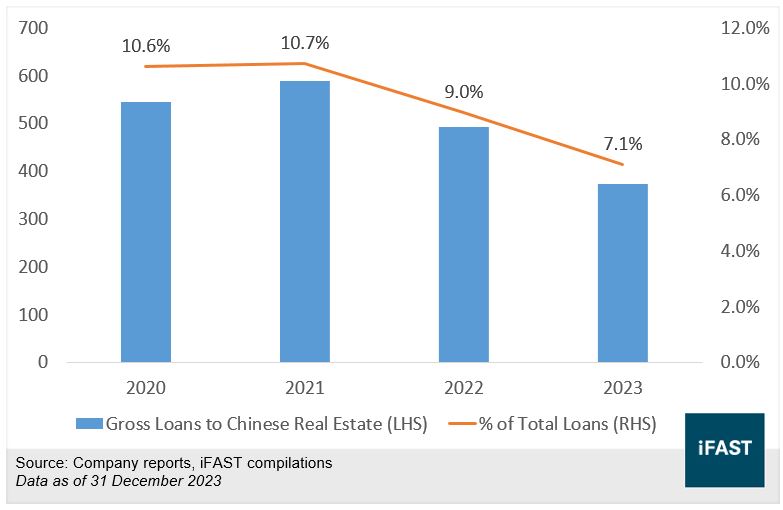
BEA is Well Capitalized with Multiple Credit Indicators Among the Best in the Industry
As of December 2023, BEA’s CET1 ratio stood at 17.3%, about 0.5 percentage points increase from June 2023, one of the highest levels in the industry and well above the regulatory requirement. The decent capital adequacy reflects a very robust ability to withstand risk. Considering BEA's announcement of a new budget of HKD 500 million share buyback and the potential redemption of AT1 (see analysis below), the CET1 ratio might drop a bit this year but is still expected to remain at an excellent level among banks.
Chart 2: BEA’s Capital Adequacy 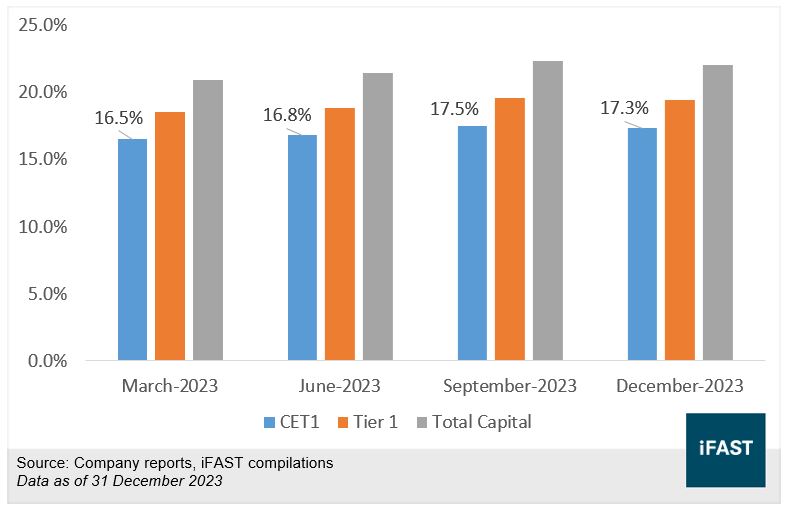 Looking at other credit metrics,
BEA’s TLAC risk-weighted ratio hit 23.3%, about 520 basis points above the
regulatory requirement as of 31 December 2023. Meanwhile, the TLAC
leverage ratio was 12.4%, also well above the regulatory requirement. Moreover, BEA's Liquidity Coverage Ratio (LCR) and Net Stable Funding Ratio
(NSFR) were 201.5% and 125.5% respectively, both of which met the regulatory
requirement of 100%, representing a solid liquidity profile.
Looking at other credit metrics,
BEA’s TLAC risk-weighted ratio hit 23.3%, about 520 basis points above the
regulatory requirement as of 31 December 2023. Meanwhile, the TLAC
leverage ratio was 12.4%, also well above the regulatory requirement. Moreover, BEA's Liquidity Coverage Ratio (LCR) and Net Stable Funding Ratio
(NSFR) were 201.5% and 125.5% respectively, both of which met the regulatory
requirement of 100%, representing a solid liquidity profile.
Table 4: BEA’s TLAC Risk-weighted Ratio and Leverage Ratio
|
Dec 2023 |
Regulatory Requirement |
Buffers Over Regulatory Requirement (bps) |
|
|
TLAC Risk-weighted Ratio* |
23.2% |
18.00% |
520 |
|
TLAC Leverage Ratio* |
12.4% |
6.75% |
565 |
|
Sources: Company report, iFAST Compilations Data as of 31 December 2023 * TLAC Risk-weighted Ratio: total TLAC / risk-weighted asset * TLAC Leverage Ratio: total TLAC/ total risk exposure |
|||
Expected a Call of Perpetual in September This Year
We note that BEA’s AT1” BNKEA 5.875% Perpetual Corp (USD)” is heading for its first call date in September this year. If it is not being called, the coupon rate will reset to the prevailing 5-year US treasury yield plus the initial spread of 4.257%. Based on the current yield level, the reset rate is at 8.62%, which is not very high given the current high-interest rate environment. So will BEA call the perpetual?
We believe that the probability of redemption of the perpetual is quite high. On the one hand, based on the track records, BEA redeemed all perpetual bonds on the first call date (Table 5). On the other hand, BNKEA 5.875% Perpetual Corp (USD) is trading at around $100, implying the market's belief that BEA would redeem the bond in September.
Table 5: BEA’s redeemed Perpetual Bonds
|
Issue Date |
First Call Date |
Redemption on First Call Date or Not |
|
|
BNKEA 5.625% Perpetual Corp (USD) |
May-2017 |
May-2022 |
Yes |
|
BNKEA 5.500% Perpetual Corp (USD) |
Dec-2015 |
Dec-2020 |
Yes |
|
BNKEA 8.500% Perpetual Corp (USD) |
Nov-2009 |
Nov-2019 |
Yes |
|
Sources: Bloomberg, iFAST Compilations Data as of 23 April 2024 |
|||
Bonds Due in 2027 Looks Attractive
In terms of bond investment, we believe that AT1 bonds are more complex and investors interested in BEA may give priority to non-AT1 bonds. Relevant information is set out below:
Table 6: Bond Investment of BEA
|
Bond |
Seniority |
Bond Credit Rating |
Years to Maturity |
YTM |
|
BNKEA 6.625% 13Mar2027 Corp (USD) |
Senior Non-Preferred |
BBB (S&P) |
2.9 |
6.6% |
|
BNKEA 6.750% 15Mar2027 Corp (USD) |
Senior Non-Preferred |
BBB (S&P) |
2.9 |
6.6% |
|
BNKEA 5.125% 07Jul2028 Corp (USD) |
Senior Non-Preferred |
BBB (S&P) |
4.2 |
7.0% |
|
BNKEA 4.000% 29May2030 Corp (USD) |
Tier 2 |
BBB- (S&P) |
6.1/1.1 (Next Call Date) |
7.2% |
|
BNKEA 4.875% 22Apr2032 Corp (USD) |
Tier 2 |
BBB- (S&P) |
8.0/3.0 (Next Call Date) |
7.1% |
|
Sources: Bondsupermart Data as of 23 April 2024 |
||||
BEA's senior non-preferred bonds have a credit rating of BBB (S&P), while Tier 2 bonds have a credit rating of BBB-, suggesting that the latter carries a relatively higher investment risk. Currently, the yield of Tier 2 bonds is around 0.4% higher than that of senior bonds, which means the risk premium is not that adequate, making Tier 2 bonds unfavorable for investment. Among senior bonds, bonds due in 2027 are yielding around 6.6%, higher than other senior bank bonds. Coupled with BEA's rather good credit quality, we believe they are a good investment choice.
It’s worth mentioning that the coupons of the three senior non-preferred bonds are adjustable, whereby if BEA does not redeem the bonds one year prior to maturity, the coupon for the final year would be reset (Table 7). Based on the figures as of 19 April 2024, the adjusted coupons for three bonds for the final year will be 7.51%, 7.31% and 7.11%, with respective projected net yield to maturity of 6.04%, 6.94% and 7.07% (based on Internal Rate of Return), which are slightly higher than the current net yield to maturity, and investors thus do not have to worry about the impact from coupon adjustment. We also notice that BNKEA 6.625% 13Mar2027 Corp (USD) has a higher projected net yield to maturity than BNKEA 6.750% 15Mar2027 Corp (USD), and investors may consider give priority to the former.
Table 7: Coupon Reset for Senior Non-Preferred Bonds
|
Bond |
Coupon Reset Date |
Reference Rate |
Projected Coupon Rate |
Projected YTM |
|
BNKEA 6.625% 13Mar2027 Corp (USD) |
13 March 2026 |
1 year UST Rate + 230 bps |
7.51% |
7.04% |
|
BNKEA 6.750% 15Mar2027 Corp (USD) |
15 March 2026 |
1 year UST Rate + 210 bps |
7.31% |
6.94% |
|
BNKEA 5.125% 07Jul2028 Corp (USD) |
7 July 2027 |
1 year UST Rate + 190 bps |
7.11% |
7.07% |
|
Sources: Bondsupermart Data as of 19 April 2024 |
||||
Corporate Risk
Investors should be mindful of the following risks. Firstly, even though BEA lowered its exposure to the Chinese property sector, default risk might emerge from the sectors other than Chinese property due to slower economic growth, which would further uplift the NPL ratio and weaken the asset quality as a result.
Secondly, all bonds issued by BEA (including senior unsecured) are embedded with the TLAC feature, which may result in a full or partial loss under some situations.
Conclusion
Bank of East Asia (BEA) retained fast-growing net interest income in 2023, while non-interest declined modestly, and profit attributable to shareholders saw a dip due to higher credit impairment loss.
BEA is reducing exposure to Chinese real estate developers, but the results are not as good as we expected. Non-performing Loan (NPL) ratio stood at 2.7%, above the industry average, and there is ample room for improvement in asset quality. CET1 ratio hit 17.3%, which is one of the best levels in the banking system, hinting at a decent capability to withstand risk.
Bonds due in 2027 yield 6.6%, which stands out among bank bonds, making them attractive investment choices.
Declaration: For specific disclosure, at the time of publication of this report, IFPL (via its connected and associated entities) and the analyst who produced this report hold a NIL position in the abovementioned securities.
Our podcast series, Yield Hunters, is available on Spotify, iTunes Podcasts and Google Podcasts. We share our thoughts on new bond issues and hold discussions on the fixed income space. Listen to our latest episode below and follow us!